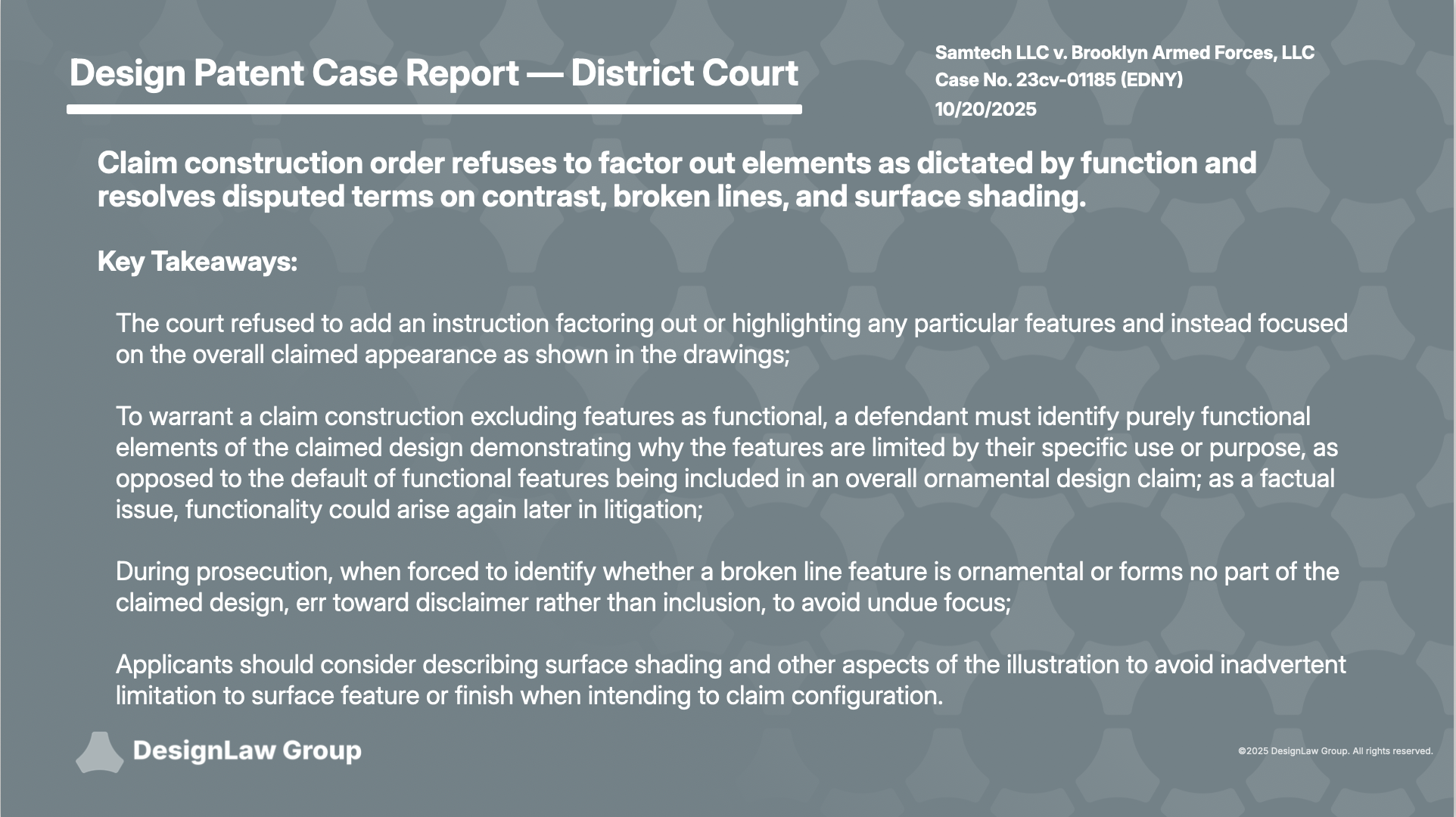

On October 20, 2025, the U.S. District Court for the Eastern District of New York (EDNY) issued a claim construction order on disputed terms and issues which are key and common in design patents, addressing functionality and the description of contrast, broken lines and shading.
Plaintiff manufactures and sells high performance apparel to consumers including the US military and owns US Patent No. D641,137 for a military style jacket.
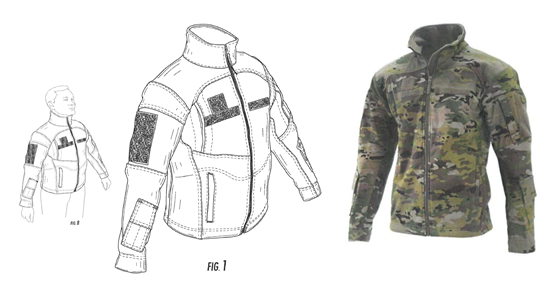
US Patent No. D641,137 and a photograph of the patent owner’s commercial product
Claim Construction
Determining infringement of a design patent requires first construing the design patent claim, then comparing the patented and accused designs to determine whether the accused design is substantially similar to the patented design.
Design patents are typically claimed as shown in the drawings and a design is better represented by an illustration than it could be by any description, the preferable course ordinarily will be for a district court not to attempt to construe a design patent claim by providing a detailed verbal description of the claimed design. Egyptian Goddess, Inc. v Swisa, Inc., 543 F.3d 665, 679 (Fed. Cir. 2008).
Nevertheless, a court may use claim construction to help guide the fact finder through issue that bear on claim scope, including distinguishing between features of the claimed design that are ornamental and those that are purely functions. Sport Dimension Inc. v. Coleman Co., 820 F.3d 1316, 1320 (Fed. Cir. 2016).
Functionality
When a court concludes that certain elements of a claimed design have functional purposes, that finding does not mean that the design claim has no scope, rather the claim is limited to the ornamental aspects of the functional elements. Id.
Here, the court refused to add an instruction identifying any elements as dictated by function.
Evaluating whether a detailed verbal description of the claimed design is necessary, the Court considered alleged functional elements, noting that an element of a design is functional and not protected by the designs patent when the appearance of the claimed design is dictated by the use or purpose of the article. Defendants point to Plaintiff’s advertising describing its jacket as having “functional features such as zippered shoulder pockets” which “provide easy access to gear, flapped pockets accommodate aviators, and a pass-through flap allows for CVC extraction straps.”
Despite this language, the Court found that Defendants had not identified a utilitarian reason why the features of the design are actually limited by their specific user or purpose to necessitate a detailed verbal description, and concluded that the claimed design as depicted in the patent illustrations is primarily ornamental.
Although alleged functional features might survive factoring out at claim construction, a district court could revisit this factual issue at later stages of litigation – see Birkenstock US BidCo, Inc. v. White Mt. Int’l LLC, 24-cv-10610 (D. Mass), claim construction order of October 17, 2025, adopting a design patent claim construction “as shown in the figures” without prejudice to the parties raising further arguments regarding functionality at summary judgement or other stages of the litigation and “without prejudice to the Court’s ultimate jury instructions on functional versus ornamental elements or any other related aspects), citing Lu v. Hyper Bicycles, Inc., 586 F. Supp 3d 68, 73 (D. Mass 2021).
Contrast
The court refused to add an instruction to highlight contrast between stitching and background.
Defendant argued for a claim construction emphasizing highly visible contrast between the stitching and the background fabric; plaintiff responded that the contrast is a byproduct of the illustration being in black and white and that the claimed design is not limited to a particular color or fabric material.
The court agreed and declined to instruct the factfinder that the claim only protects stitching which contrasts with the background material.
Design patent claims may generally cover contrasting surfaces unlimited but colors, and are not limited to specific materials. Sealy Tech., LLC v. SSB Mfg. Co., 825 F. App’x 795, 797 (Fed. Cir. 2020).
Defendants argued that the patent claims “highly visible contrast” between stitching and background fabric, but considering that design patent applications typically contain black and white illustrations, gave the Court no reason to believe that the contrast between the stitching patterns and the fabric requires description.
Broken Lines
The court refused to add an instruction highlighting a particular feature as being part of the claim.
Plaintiff proposed language that the broken lines on the surface of the jacket represent stitching and are part of the claim.
This is consistent with language in the patent itself, introduced by the USPTO Examiner’s amendment in the Notice of Allowance in the subject design patent application, and is generally consistent with USPTO practice – broken lines are typically required to be described as environment or portions of the article, and because broken line depiction of stitching could be an ornamental feature, during examination, a USPTO Examiner will typically require clarification of whether broken lines are part of the claim or not.
During prosecution, when faced with an Examiner requirement to identify whether a broken line feature forms part of the claimed design or not, it would be prudent decline, out of concern that calling out one feature will require it for a finding of infringement.
Fortunately, the court was not moved to add an instruction highlighting one particular feature of the design patent as being part of the claim and left it for the factfinder to determine whether the patterns and shape of the stitching shown in the illustrations contribute to an overall visual impression that the patented design and accused jackets are substantially similar.
The court allowed plaintiff’s proposed language indicating that the broken line showing the human form (e.g., in FIG. 8) form no part of the claim, and with those broken lines addressed, the remaining broken lines without explanation are left as part of the claim.
Shading
Significantly, the court also allowed plaintiff’s statement that the “surface lines shown on the surface of the jacket indicate shading.” The court noted that the 37 CFR §1.152 provides that “appropriate and adequate surface shading should be used to show the character or contour of the surfaces represented” and therefore found plaintiff’s instruction regarding shading appropriate.
This is a boon for practitioners endeavoring to clearly direct design patent claims and avoid inadvertent and undue limitation based on misunderstanding of the illustrations or applicant’s claim intent.
Such a statement can avoid misunderstanding of surface shading as surface ornamentation or a surface feature.
For example, in 2020, a district court questionably construed contour lines as claimed seam features, evident in the design patent’s line drawings but not discernible in photographs of the patented or accused designs.
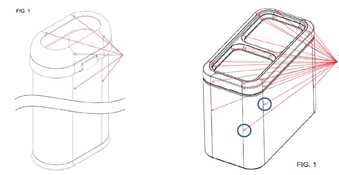
And in 2022, a district court concerningly limited a design patent claim to opaque when illustrated with computer generated images instead of line drawings and found no infringement by a closely shaped transparent design.
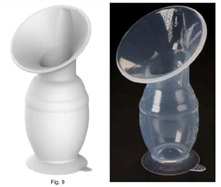
In view of these outcomes, applicants and practitioners are encouraged to clearly describe design patent drawings and claims.
USPTO Examiners, working hard to reduce backlog and examine efficiency, may be disinclined to allow such statements and argue that description of shading is unnecessary as it is well known.
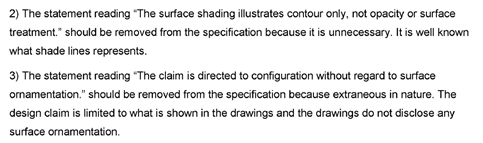
Excerpt from USPTO rejection from November 2025.
These cases demonstrate that it is permissible and important for Applicants and practitioners to clearly describe claimed designs.
Discrepancies
The court also declined to issue a verbal description of the claimed design to address alleged discrepancies identified by defendant, for example, differences in elements of design between the left and right sleeve, finding no reason why the fact finder will be unable to evaluate the positions of the pockets on the sleeves as part of the overall appearance and comparison between accused and patented designs.
Litigation continues in the case, Samtech LLC v. Brooklyn Armed Forces, LLC, 23-cv-01185 (EDNY).
Takeaways
- The court refused to add an instruction factoring out or highlighting any particular features and instead focused on the overall claimed appearance as shown in the drawings;
- To warrant a claim construction excluding features as functional, a defendant must identify purely functional elements of the claimed design demonstrating why the features are limited by their specific use or purpose, as opposed to the default of functional features being included in an overall ornamental design claim; as a factual issue, functionality could arise again later in litigation;
- During prosecution, when forced to identify whether a broken line feature is ornamental or forms no part of the claimed design, err toward disclaimer rather than inclusion;
- Applicants should consider describing surface shading and other aspects of the illustration to avoid inadvertent limitation to surface feature or finish when intending to claim configuration.