


Specific Designs
District Court grants summary judgement of non-infringement of a design patent, construing the title and claim as limited to a specific piece of an article of manufacture and finding the accused product to incorporate the design elsewhere on the article, out of infringement scope.
Key Takeaways:
- District Court decision reinforces how identifying the article of manufacture in the title, claim and drawings impacts design patent scope.
- Demonstrates how courts may rely on intrinsic evidence to interpret disputed article of manufacture terminology.
- Builds on Curver and SurgiSil by illustrating how courts determine what article of manufacture language actually refers to.
- Highlights the growing importance of article of manufacture designations under the USPTO’s 2026 Supplemental Guidance.
- Emphasizes the value of consistent titles, terminology, and prosecution strategy across related design patent applications.
The Western District of Wisconsin’s decision in MCP IP, LLC v. Ravin Crossbows, LLC may appear at first glance to be a straightforward application of established design patent principles. The court reiterated the familiar rule that a design patent protects a design only as applied to a particular article of manufacture, not a design in the abstract. But viewed in the context of recent Federal Circuit precedent and evolving USPTO practice, the opinion may suggest something more significant. As the article of manufacture becomes less visually apparent from the drawings themselves, courts may increasingly turn to other evidence to determine the scope of a claimed design and the meaning of the words used to identify that design’s article of manufacture.
The D’195 Patent and the Importance of “Crossbow Rail”
The dispute involved U.S. Patent No. D868,195, entitled “Crossbow Rail” owned by MCP. The D’195 patent claimed an ornamental design consisting of a series of triangular cutouts incorporated into a rail component of a crossbow. Notably, the patent included only a single drawing depicting the rail itself. The drawings did not show the rail in the context of the crossbow or otherwise indicate where the claimed component was located within the overall product.
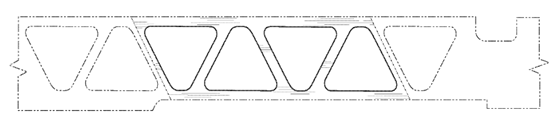
The omission became central to the parties’ dispute. Ravin contended that the designation “crossbow rail” referred specifically to the principal rail that guides the arrow. MCP, by contrast, argued that the claimed design extended more broadly to similar rail-like structures on Ravin’s products, including supports associated with a Picatinny rail, which is used to mount accessories rather than guide the arrow.
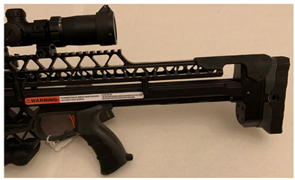
Accused Design
Because the drawings alone did not resolve which component the term “crossbow rail” identified, the court was required to determine what the patent’s article of manufacture designation actually referred to.
Once the court concluded that the D’195 patent was directed specifically to the principal guiding rail, the infringement analysis became straightforward. Although similar triangular cutout features appeared on the accused products, those features were located on different components rather than on the claimed rail itself. Because the accused designs were not applied to the same article of manufacture identified by the patent, the court agreed with Ravin and granted summary judgment of noninfringement.
Looking Beyond the Patent Drawings
The court’s reasoning is significant not because it departed from the traditional role of the drawings in design patent law, but because the drawings themselves did not resolve the central issue before the court. The D’195 patent contained only a single figure depicting the claimed rail in isolation. Unlike many design patents, it did not show the component in the context of the larger product or otherwise identify where the claimed design was situated within the crossbow. As a result, the title, “Crossbow Rail,” became the primary indicator of the claimed article of manufacture. The dispute therefore was not whether the article of manufacture mattered, but what the applicant meant by the words used to identify it.
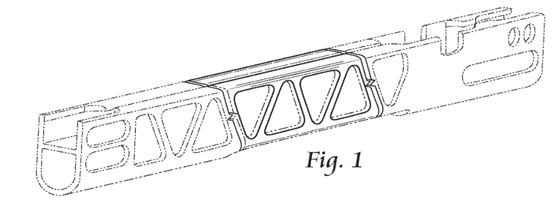
Rather than attempting to answer that question from the D’195 patent alone, the court examined the intrinsic record to determine how MCP itself had used the designation “crossbow rail.” Its analysis focused primarily on the related D868,194 patent. The D’194 and D’195 patents were filed on the same day by MCP, shared the identical title “Crossbow Rail,” and claimed different ornamental aspects of what appeared to be the same underlying component. Unlike the D’195 patent, however, the D’194 patent depicted the rail in a three-dimensional perspective, including the arrow flight track running along its upper surface. Those drawings provided additional context for the applicant’s use of the term and supported the conclusion that “crossbow rail” referred to the principal rail that guides the arrow rather than to any rail-like structure incorporated elsewhere on the crossbow.
The prosecution history reinforced that understanding. During examination of the D’195 application, the examiner issued a nonstatutory double patenting rejection over the D’194 patent, reflecting the Office’s view that the applications were directed to closely related subject matter. MCP responded by filing a terminal disclaimer, further linking the patents and confirming their common ownership.
Taken together, the related patent and its prosecution history persuaded the court that the D’194 and D’195 patents concerned the same physical component and that the designation “crossbow rail” referred specifically to the principal arrow-guiding rail. That determination ultimately resolved the infringement dispute. Although Ravin’s products incorporated similar triangular cutout features, those features appeared on different components associated with a Picatinny rail rather than on the article of manufacture identified by the D’195 patent.
Viewed more broadly, the opinion illustrates that article of manufacture designations cannot always be interpreted from the drawings alone. Where the drawings provide limited context, courts may look to related patents, prosecution history, and other intrinsic evidence to determine how the applicant itself used the words identifying the claimed article of manufacture. That approach is particularly noteworthy as design patents increasingly rely on titles and claims, rather than visual depictions, to identify the relevant article of manufacture.
Building on Curver and SurgiSil
The decision fits naturally within the framework established by Curver Luxembourg, SARL v. Home Expressions Inc. and In re SurgiSil, L.L.P. Neither decision created the longstanding principle that design patents protect designs only as applied to particular articles of manufacture, but both gave that principle renewed practical significance.
In Curver, the Federal Circuit held that claim language identifying a chair limited the scope of a pattern design even though the drawings depicted only the ornamental pattern itself. Notably, the importance of the article of manufacture first arose during prosecution. Curver originally sought protection for a design entitled “Furniture (Part of),” but the USPTO objected to the title because it failed to designate the particular article to which the design was applied, as required by 37 C.F.R. § 1.153. In response, the title was amended to “Pattern for a Chair,” with the claim directed to “the ornamental design for a pattern for a chair.”
The Federal Circuit later gave that amendment substantive legal effect. Although the drawings remained directed only to the pattern, the Federal Circuit held that the words used to identify the article of manufacture limited the scope of the patent to chairs. As a result, the patent could not be asserted against baskets incorporating the same pattern. Curver thus demonstrates that the terminology chosen during prosecution may have lasting consequences throughout the life of the patent – a point that may take on even greater significance as the USPTO permits greater flexibility in how articles of manufacture are depicted.
Likewise, in SurgiSil, the Federal Circuit reinforced the importance of the article of manufacture in the validity context. The case arose after the Patent Trial and Appeal Board affirmed an anticipation rejection of a claimed lip implant design based on a similarly shaped artist’s blending stump. In doing so, the Board concluded that “it is appropriate to ignore the identification of the article of manufacture in claim language” and instead compare only the visual appearance of the claimed design and the prior art.
The Federal Circuit rejected that approach. Reversing the Board, it explained that “a design claim is limited to the article of manufacture identified in the claim” and that the claimed design therefore had to be evaluated as applied to a lip implant, not as an abstract ornamental shape. Because the cited prior art was directed to a fundamentally different article of manufacture, the court concluded that it could not anticipate the claimed design. In doing so, the court reinforced that the article of manufacture identified in a design patent is an integral part of the anticipation analysis, not simply descriptive claim language.
Together, Curver and SurgiSil underscore that the words used to identify an article of manufacture carry substantive legal consequences, affecting both infringement and validity. Curver demonstrates that those words may define the scope of design patent protection, while SurgiSil confirms that they likewise define the framework for evaluating prior art. MCP builds on those principles by addressing a different question: how should a court determine what the applicant intended those words to mean when their meaning is disputed? Rather than relying solely on the patent title or drawings, the court examined the intrinsic record to determine what the term “crossbow rail” referred to, treating related patents and prosecution history as important evidence of how the applicant used that terminology.
A Timely Development
The significance of MCP is particularly apparent in light of recent changes in USPTO examination practice. Under the USPTO’s 2026 Supplemental Guidance concerning computer-generated interfaces and icons, applicants are no longer required to depict a computer, monitor, or other display device when the title and claim identify the article of manufacture. Rather than requiring the article to be shown in the drawings, the Office now recognizes that it may be identified through the words used in the title and claim.
Although the 2026 Supplemental Guidance is generally welcome for allowing much more flexibility in titling design patent applications directed to graphical user interfaces and icons, as opposed to limiting their appearance to a display screen, panel or monitor, rather than incorporate new terminology as some examples suggest, for example, augmented reality, practitioners are cautioned that less specific designations, e.g. “computer interface” or “computer icon” could suffice.
Viewed against that backdrop, MCP raises an important question. If the drawings provide less information about the article of manufacture, how will courts determine what those article of manufacture terms actually refer to?
MCP suggests that courts may increasingly answer that question by turning to the intrinsic record. Just as the court looked to related patents, the prosecution history, the examiner’s nonstatutory double patenting rejection, and the terminal disclaimer to understand what “crossbow rail” encompassed, future courts may likewise consult surrounding context to interpret the article of manufacture when the drawings alone provide limited guidance.
For design patent practitioners, MCP serves as a reminder that the designation of the article of manufacture is more than a filing formality. Historically, practitioners have focused primarily on the drawings because the drawings define the claimed design. That principle remains unchanged. But as the USPTO permits greater flexibility in identifying articles of manufacture without requiring them to be visually depicted, greater attention may need to be paid to the terminology used in titles and claims as well as to maintaining consistency across related applications and throughout prosecution. Those materials may ultimately influence not only how a court construes the article of manufacture, but also the resulting scope of infringement and the validity analysis.
The case, MCP IP, LLC v. Ravin Crossbows, LLC, No. 3:2022cv00004, remains in litigation.
Kyra Ducoat, Associate
kyra.ducoat@designlawgroup.com
George Raynal, Principal


